
Saline County Court Records After Arrest
After a Saline County jail arrest, the jail record and the court record move on related but separate tracks. The Saline County Law Enforcement Center may hold the person, record the intake, and show initial offense or bond information through the shared regional roster. The first appearance brings the person before the court for early rights, bond, and scheduling issues. The formal court record starts when a filing reaches County Court or District Court. In Nebraska counties, that filing is driven by the County Attorney rather than a district attorney.
Saline County Attorney David Solheim is the local prosecutor for felony and misdemeanor crimes that occur in the county. His office reviews reports, decides what charges to file, and handles prosecution after the arrest. The jail's initial offense can be useful, but it is not the final charge list. For custody and booking detail, use the Saline County jail inmate records path. For booking photos, use the Saline County jail mugshots page, since court records are charge files, not a mugshot database.
The official Saline County Attorney page identifies the prosecutor's role, office hours, and contact route for local prosecution work.
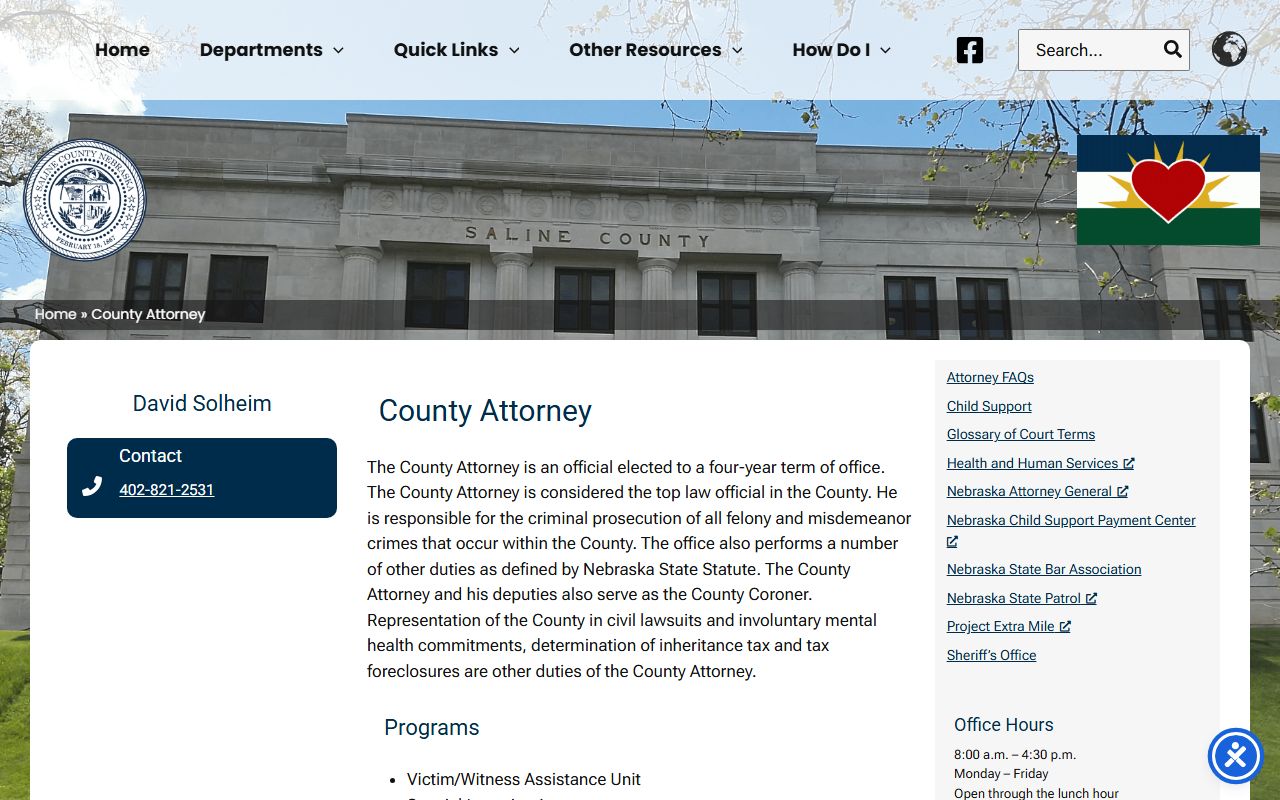
That office is the charging authority, while the court clerk keeps the case record once the charge is filed.
Search Saline County Arrest Court Records
The statewide case-search route is Nebraska JUSTICE and SCCALES case information. The Nebraska Judicial Branch says the system covers criminal, civil, traffic, juvenile, and probate cases in Nebraska county and district courts. For a new Saline County arrest, the key limit is timing: the Judicial Branch states that new entries have a 24-hour lag before they appear in the public search. If the arrest just happened, the jail may know more than the case index.
The Nebraska Judicial Branch case information page describes case-search options, courthouse access, fees, registers of actions, and document images.
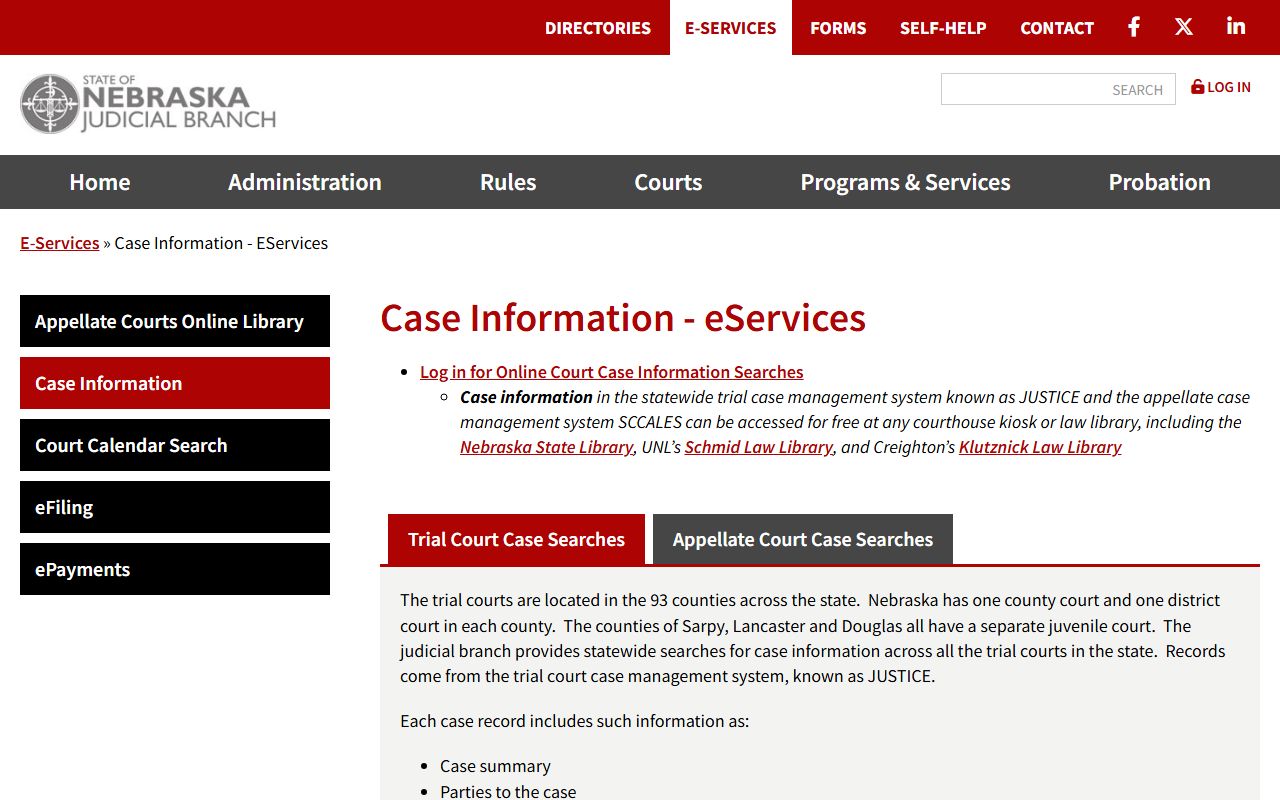
Use that source to understand what the court search can show before relying on the jail roster as a charge record.
| JUSTICE Search Item | Saline County Use |
|---|---|
| Party name | Search by the defendant's name. A party is a person involved in the case, not a witness. |
| County filter | Use Saline to narrow name results when the same name appears in other counties. |
| Court type | Check County Court for misdemeanor, traffic, and many early matters. Check District Court for felony cases. |
| Case type or subtype | Use criminal or traffic filters when a broad name search returns too many matches. |
| Year | Narrow by the arrest or filing year if the name is common. |
| Cost and access window | A one-time party-name search costs $17, returns up to 30 cases, and gives access for three calendar days. |
| Lag time | Expect a 24-hour lag after a new case is entered. |
Saline County Court Records Contacts
Court routing depends on the charge and case stage. County Court handles misdemeanors, infractions, traffic matters, and other lower court work. District Court handles felony criminal cases, equity, domestic relations, and higher-value civil matters. A person can be arrested on one offense, then see the case move or change after the County Attorney files the formal charge.
Saline County Court
204 South High Street, PO Box 865
Wilber, NE 68465
Phone: 402-821-2131
Fax: 402-821-2132
Judicial Branch hours: 8 a.m. to 5 p.m., Monday through Friday
Saline County Clerk of District Court
204 South High Street
Wilber, NE 68465
Phone: 402-821-2823
Fax: 402-821-3179
Email: amber.mulbery@nejudicial.gov
The Saline County Clerk of District Court page identifies the clerk's criminal filing and court-record duties.
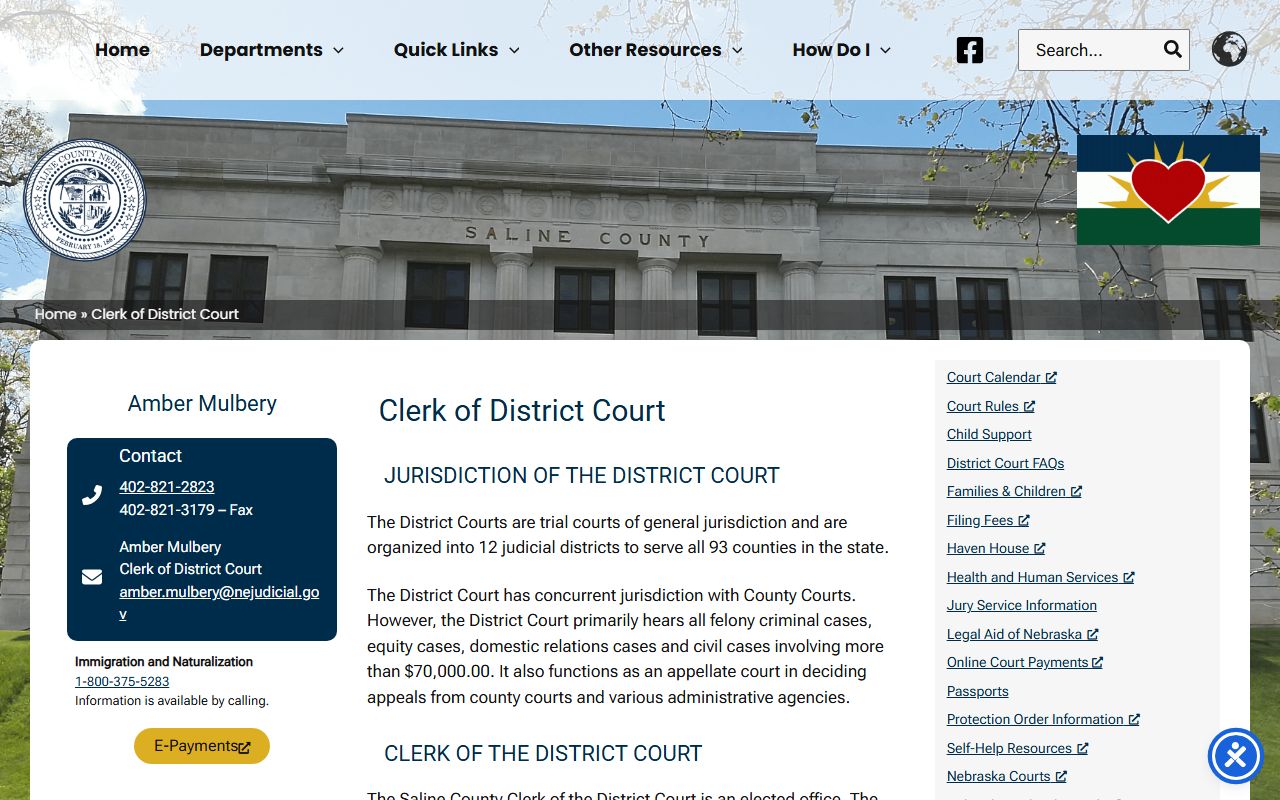
For older felony files, unclear case numbers, or docket entries that do not match a jail booking, the clerk contact is often the practical next step.
Saline County Arrest Charging Records
A charge becomes part of the court record through a charging document. The booking event may list an initial offense, but the court case reflects what the prosecutor files. That is why a Saline County court records after arrest search should compare the jail offense, the filed document, and the later register of actions before drawing a conclusion.
| Document | Who Uses It | What It Means |
|---|---|---|
| Complaint | Prosecutor or law enforcement process | A written accusation that can start a criminal case, often seen in misdemeanor or early felony handling. |
| Information | County Attorney | A prosecutor-filed charging document often used for felony charges after review. |
| Indictment | Grand jury | A formal charge returned through grand jury action. It is less routine than complaint or information practice. |
When the document is filed, the case record can include parties, court costs, payments, a register of actions, and document images filed or uploaded after April 16, 2008. The register of actions is the docket activity list. It shows events such as filings, hearings, warrants, bond orders, pleas, and dispositions.
Saline County Charge Status Records
Charge status changes as the case moves. A charge can be pending, amended, reduced, dismissed, or resolved by plea or trial. A booking charge may also look different from a filed charge because the County Attorney reviews reports before filing. For that reason, use the court record for formal charge status and the jail roster for current custody.
| Status | Plain Meaning | Why It Matters |
|---|---|---|
| Pending | The charge is open and has not reached final disposition. | Hearings, bond orders, and filings may still change the case. |
| Amended | The prosecutor changed the filed charge or details. | The filed court charge may no longer match the arrest offense. |
| Reduced | The charge level or offense was lowered. | A felony may move toward a lesser felony or misdemeanor result. |
| Dismissed | The court ended that charge without a conviction on it. | Other charges in the same case may still remain. |
| Disposition | The current or final result of a charge. | This is the entry to read before treating a charge as a conviction. |
Bond Records After Saline Arrest
Bond is set through the court or by court-authorized procedures, not by a website search alone. Saline County did not publish a detailed jail bond page in the accessible official text, so current bond amounts, payment methods, and release blocks should be confirmed with Saline Corrections or the court of jurisdiction. The local jail and sheriff number is 402-821-2111. County Court is 402-821-2131, and the District Court Clerk is 402-821-2823.
| Bond or Hold Type | How It Works | Saline County Checkpoint |
|---|---|---|
| Cash bond | Money is paid to satisfy the court-set release amount. | Call the jail and court before payment because Saline payment rules were not published. |
| 10 percent cash | A partial cash deposit may be allowed if ordered by the court. | Regional Nebraska pages mention this, but Saline staff should confirm any local use. |
| Surety bond | A bond agent may post surety when the court permits it. | Confirm whether the court order allows surety and whether holds exist. |
| Personal recognizance | The person is released on a promise and conditions instead of full cash. | This is a court decision, not a roster entry. |
| No-bond hold | The person cannot be released on local bond alone. | Possible with warrants, federal holds, ICE issues, parole, probation, or another county. |
Warrants in Saline County Records
No official Saline County active warrant list was found in the accessible source sweep. Do not treat a private list as the county's warrant search. The practical path is the Saline County Sheriff's Office or Corrections non-emergency number, 402-821-2111, plus the court clerk if the warrant is tied to a bench warrant or court case.
A warrant can become a jail record once the person is arrested and booked. An arrest warrant is tied to an alleged offense. A bench warrant is issued by a judge, often for failure to appear or violating a court order. A fugitive warrant or hold may involve another county. A federal warrant can involve the U.S. Marshals District of Nebraska at 402-501-6700. NEVCAP is useful for custody alerts after arrest, but it is not a warrant search.
Charges Versus Convictions
An arrest and a filed charge do not equal a conviction. This distinction is central to Saline County court records after arrest because many records show accusations before any final result. Read the disposition before using a charge as proof that a person was convicted.
| Point | Charge | Conviction |
|---|---|---|
| Stage | An accusation filed in court after arrest review. | A guilty plea, guilty verdict, or other conviction result. |
| Proof level | Can be based on probable cause and prosecutor review. | Requires proof beyond a reasonable doubt or an accepted plea. |
| Record language | May appear as pending, amended, reduced, or dismissed. | Appears through disposition, sentence, judgment, or plea entries. |
| Use caution | Do not call it a conviction without the final entry. | Still verify identity, court, and case number. |
Sealed and Expunged Records
Nebraska public access starts with broad public-record rules, but criminal history information has limits. Neb. Rev. Stat. Section 29-3523 governs public inquiry, dissemination limits, removal, and expungement or error processes for criminal history record information. Juvenile arrest history is treated differently from adult criminal history. Acquittals, dismissals, errors, and eligible record-sealing situations need careful review through the court or the Nebraska State Patrol process.
| Point | Sealed | Expunged or Removed |
|---|---|---|
| Public view | Public access is restricted by court order or law. | The record is removed, corrected, or treated under a statutory expungement/removal rule. |
| Source | Usually handled through court sealing procedures. | May involve Section 29-3523 processes for criminal history errors or eligible outcomes. |
| Effect | Some agencies may still have limited lawful access. | Public dissemination may be restricted, but the exact effect depends on the statute and order. |
| Best record to check | Court order and clerk record. | Nebraska State Patrol criminal history response and court record. |
The Nebraska State Patrol criminal history request page explains public criminal history requests, fees, channels, and redaction limits.
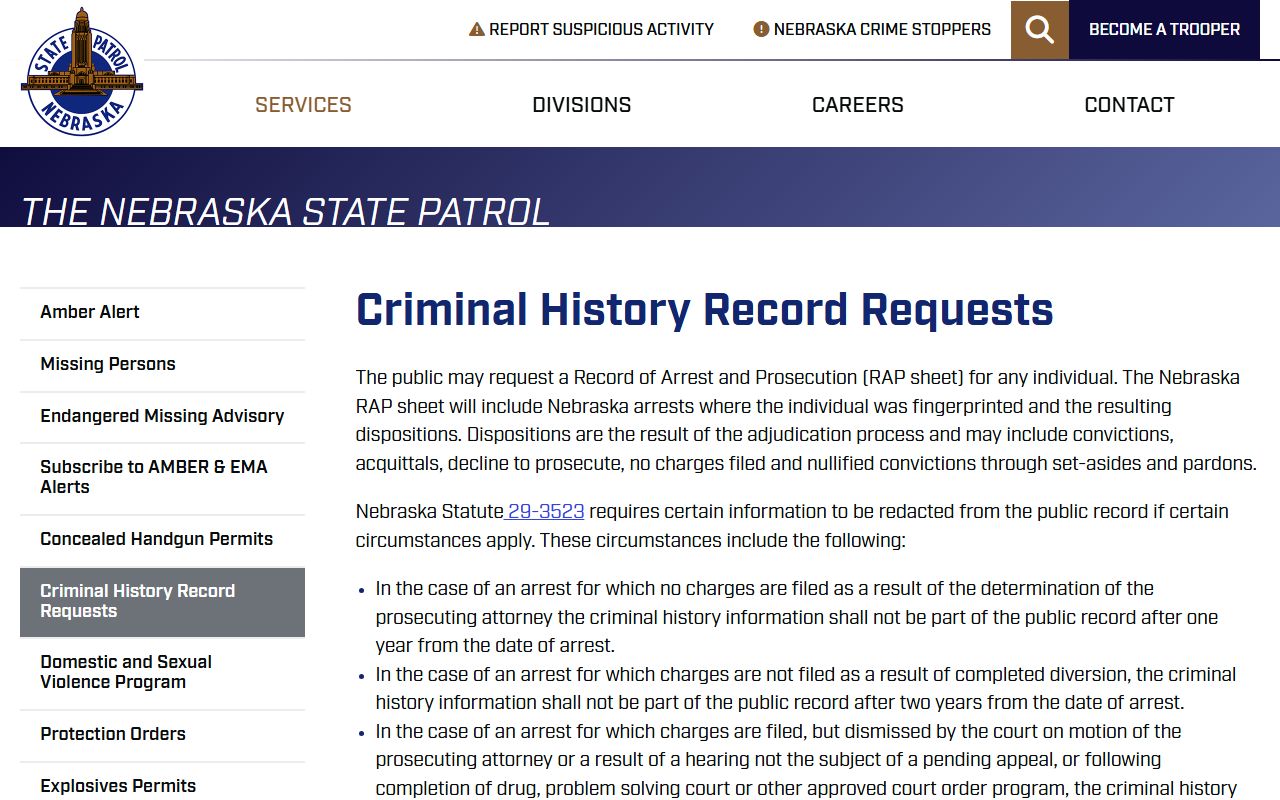
Use that record path for statewide criminal history, while using Saline County courts for case-specific charge and disposition detail.
Public Records and Criminal History Limits
Neb. Rev. Stat. Section 84-712 gives interested persons the right to inspect and copy public records unless another law provides otherwise. Section 84-712.01 defines public records broadly for state, county, city, village, and other public agencies. Those rules support requests for jail logs, booking records, and court-related local records, but they do not make every law-enforcement detail public.
Neb. Rev. Stat. Section 29-3523 is the main limit to remember for criminal history dissemination. It affects what appears in a public criminal history response and includes rules for removals, errors, acquittals, dismissals, and expungement treatment. A Saline County court record may show the case path, while a State Patrol criminal history report may omit or limit some items under state law.
Important: This resource is privately operated, is not a consumer reporting agency, and cannot be used for FCRA-covered screening decisions.